Two Guilds Struck in the Same Summer
Residuals in 2007, AI clauses in 2023: the Writers Guild and SAG-AFTRA keep fighting the same fight with different names for the technology.

The Argument That Never Closed
When the Writers Guild of America called its members out in November 2007, the central demand concerned DVD residuals and compensation for streaming content — then a novelty represented chiefly by early Netflix and YouTube. The strike lasted 100 days, cost the Los Angeles economy an estimated $2 billion by industry accounts, and ended in February 2008 with a deal that established a residual formula for internet-distributed content: a small percentage of distributor revenue on a sliding scale, with a minimum guaranteed payment for ad-supported streaming. It was the first time any major Hollywood guild had won contractual language specifically addressing what would later be called the streaming economy.
The settlement was incomplete almost immediately. The formula negotiated in 2008 assumed streaming was a secondary window — background income, not the primary revenue model of the entire industry. Within five years, that assumption had collapsed.
The Summer Two Guilds Walked Out
In May 2023, the WGA struck again. SAG-AFTRA joined it in July, producing the first simultaneous stoppage by both guilds since 1960. Two issues dominated: the failure of existing residual structures to reflect streaming's dominance, and — new to collective bargaining anywhere in the entertainment industry — the regulation of artificial intelligence. The Alliance of Motion Picture and Television Producers had declined to commit to protections preventing studios from training AI models on writers' scripts or replicating actors' digital likenesses without consent or compensation.
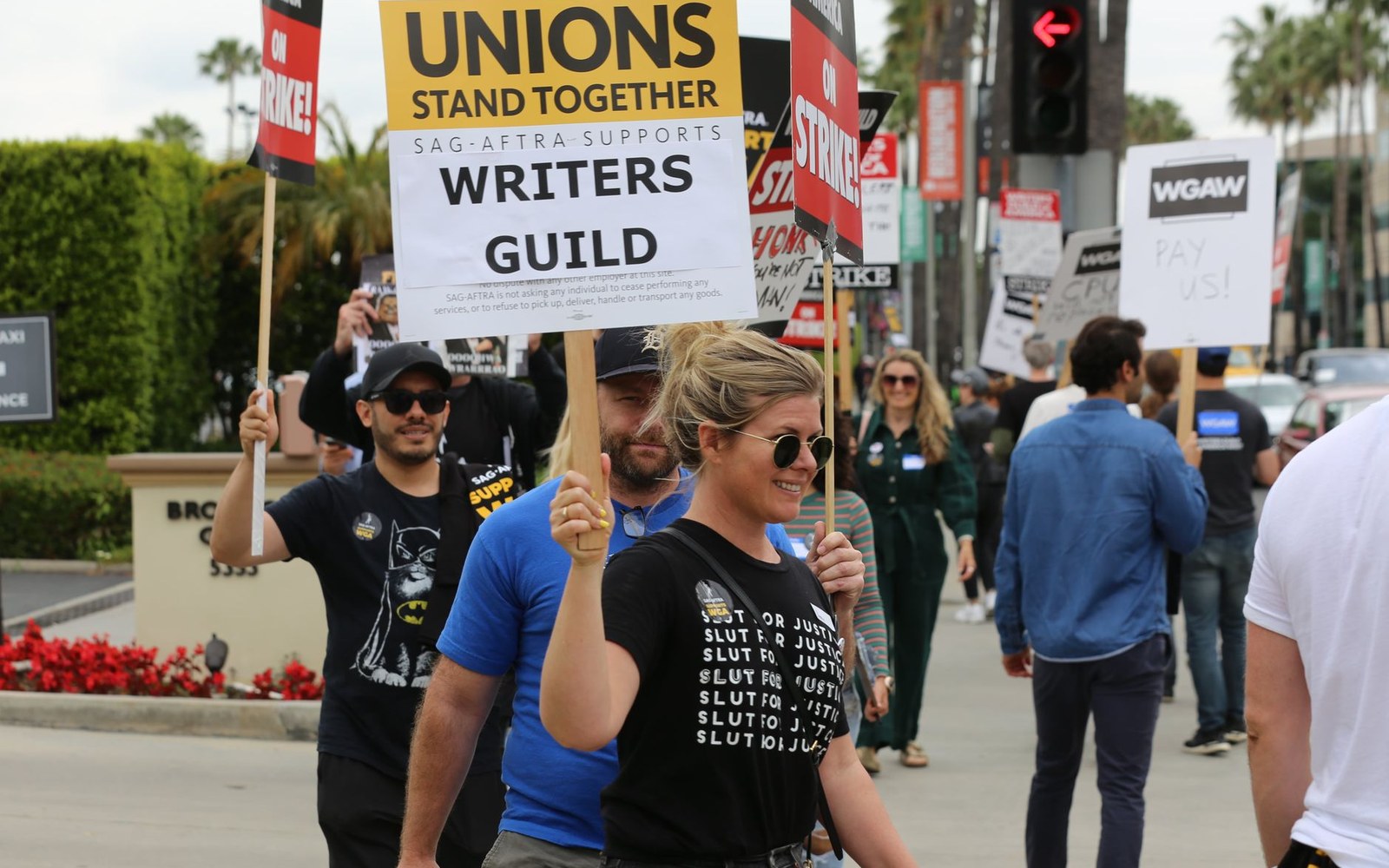
The WGA reached a settlement in September 2023 after nearly 150 days; SAG-AFTRA concluded its agreement in November. The combined WGA deal included minimum staffing requirements for writers' rooms, improved residual rates tied to the size of a streaming platform's subscriber base, and — crucially — explicit AI provisions: studios could not use AI-generated material as source text for a writer to polish, and could not use AI to undercut minimum compensation. The SAG-AFTRA agreement added protections around digital replicas and the training of AI systems on a performer's image or voice without individual consent.
The structural argument in both disputes was identical to the one SAG-AFTRA and the WGA have prosecuted across their histories: when a new distribution technology reshapes how content reaches audiences, the people who make it are entitled to a share of the value it generates. In 2007, that technology was broadband streaming. In 2023, it was large-language models and synthetic media. The guilds that negotiated those provisions — institutions built across a century of collective bargaining for workers who were never employees — are, structurally, the same organisations that struck before.

Elsewhere in Organising